
3One can not simplify the meaning of Taekwon-Do, but to put it in its most basic form, Taekwon-Do was originated in Korea and is not only the art of kicking and punching, but the wisdom of life.
Taekwon-Do is not merely a version of unarmed combat designed for self-defence, but it is also the scientific and ultimate use of body gained through intensive phisical and mental training. Taekwon-Do was designed on the fundamentals of kinetic and potetial energy due to velocity and gravity respectively. By applying these principles together correctly along with the teory of power, Taekwon-Do will creates unequal power and technique.
Though Taekwon-Do is an independence martial art, uniquely with its discipline, techniques and mental training are the fundamental for building a strong sense of justice, fortitude, humility and loyalty. It is the mental conditioning and soul realisation of caring and love to all living natures that seperates the true practitioner from the sensationalist content with mastering only the fighting aspects. This is the one of the reasons that Taekwon-Do is called an art of self-defense. It also implies a way of life, particularly in instilling a concept of self-imposed discipline and an ideal of noble moral rearmament.
Through devoted training one can gradually attain mental fitness. By practising and repeating each step to perfection, we bwcome more patient. Self-confidence is attained through the power of one's body and the knowledge of how to use it at any place and in any situation. Sparring helps us buildhumility, courage, alertness, and acuracy and develops self co-ordination. Through discipline and interaction with others, we learn co-operation and mutual respect. Prejudices are not welcome and we soon learn that racial barriers only stand in the way of our training.
There are many physical benefits for a person who practises Taekwon-Do. along with developing a healthier, leaner and more flexible body, we also increase endurance through a typical training regime. The health-related effects of training are numerous. Taekwon-Do training:
1. Helps to release stress and enhances concentration
2. Builds strength, agility and flexible
3. Helps the lungs to operate more efficiently
4. Conditions the heart
5. Enlarges the blood vessels and lowers the diastolic blood pressure
6. Increase blood supply to all parts of the body
7. creates healthier body tissue by supplying it with more oxygen
8. Promotes better sleep and waste elimination

Showing posts with label (K) LESSON. Show all posts
Showing posts with label (K) LESSON. Show all posts
THE PHILOSOPHY OF TAEKWON-DO
Although the literal translation on Taekwon-Do is "the art of kicking and punching", (Tae means "to kick", Kwon means 'to punch" and Do means "art") this is no more than a superficial translation. Do in Korean implies the philosophical approach to a way of life, a pathway to achieve enlightenment. The students of a Taekwon-Do, through rigorous physical.
The true Taekwon-Do practitioner extends this art to all aspects of life, in order to achieve harmony with nature and thus a stable and peaceful existence. Taekwon-Do is not only an excellent method of self defense, but a way of life. These qualities can be traced back to its aim of the "Mastery of Self". Through the philosophy of Taekwon-Do, a student can rid him or herself of the ego, and live in harmony with the universe.
At the center of this philosophy, is the concept of interaction between opposing forces in nature (Yin vs. Yan). Equilibrium is only achieved when contrary forces are distributed in equal amounts, resulting in balance and harmony. When only one force dominates, however, the result is unbalance, which could mean discord or failure.
In today's society there are relatively fewer chances to encounter a life threatening situation than when Taekwon-Do was first developed. To spend several years of ones life would seem a high price to pay for the chance to defend yourself in the not-so-likely event of a fatal attack. Therefore, it is the more spiritual part of Taekwon-Do what should motivate somebody to become one of its pratitioners. For some people, the causes could be simply fitness or the desire to train and excel in the sport. Taekwon-Do will very fit the necessities of these people, however, a true practitioner of the art should never forget the importance of the philosophical and spiritual parts of Taekwon-Do as well the physical ones. Whoever makes this mistake will not experience all the benefits that art can provide to its true practitioners.
Taekwon-Do also teaches the importance of responsibility and honesty as the means to achieve harmony with society. The true Taekwon-Do student is the one that knows how to behave in any place and at any time. It is very important to stress the need that our world has of trustworthy and sincere people. This are the kind of people that Taekwon-Do is most probably associated to. This should be the insignia for which anybody could recognize the Taekwon-Do practitioner.
Respect, humility and high sense of morality are also important teachings that all of those who practice Taekwon-Do should learn. Respect could never be over stressed, because it is respect what maintains healthy the master-student relationship. If the student does not respect his master, he will never become worthy of the masters trust, and therefore his presense in the Dojang will not be welcomed. Respect is an important subject in Taekwon-Do, Respect is expected from all students toward their parents, their nation, their master and fellow students, and in general toward all human beings.Humility is a quality that all serious Taekwon-Do students should possess. Although it is true that practising the art of Taekwon-Do boosts your self confidence, this should not convey the false sense of superiority. On the contrary, the good student should be humble and considerate. In the same way, the highest regard for morality and ethics should be observed by all Taekwon-Do practitioners.
The true Taekwon-Do practitioner extends this art to all aspects of life, in order to achieve harmony with nature and thus a stable and peaceful existence. Taekwon-Do is not only an excellent method of self defense, but a way of life. These qualities can be traced back to its aim of the "Mastery of Self". Through the philosophy of Taekwon-Do, a student can rid him or herself of the ego, and live in harmony with the universe.
At the center of this philosophy, is the concept of interaction between opposing forces in nature (Yin vs. Yan). Equilibrium is only achieved when contrary forces are distributed in equal amounts, resulting in balance and harmony. When only one force dominates, however, the result is unbalance, which could mean discord or failure.
In today's society there are relatively fewer chances to encounter a life threatening situation than when Taekwon-Do was first developed. To spend several years of ones life would seem a high price to pay for the chance to defend yourself in the not-so-likely event of a fatal attack. Therefore, it is the more spiritual part of Taekwon-Do what should motivate somebody to become one of its pratitioners. For some people, the causes could be simply fitness or the desire to train and excel in the sport. Taekwon-Do will very fit the necessities of these people, however, a true practitioner of the art should never forget the importance of the philosophical and spiritual parts of Taekwon-Do as well the physical ones. Whoever makes this mistake will not experience all the benefits that art can provide to its true practitioners.
Taekwon-Do also teaches the importance of responsibility and honesty as the means to achieve harmony with society. The true Taekwon-Do student is the one that knows how to behave in any place and at any time. It is very important to stress the need that our world has of trustworthy and sincere people. This are the kind of people that Taekwon-Do is most probably associated to. This should be the insignia for which anybody could recognize the Taekwon-Do practitioner.
Respect, humility and high sense of morality are also important teachings that all of those who practice Taekwon-Do should learn. Respect could never be over stressed, because it is respect what maintains healthy the master-student relationship. If the student does not respect his master, he will never become worthy of the masters trust, and therefore his presense in the Dojang will not be welcomed. Respect is an important subject in Taekwon-Do, Respect is expected from all students toward their parents, their nation, their master and fellow students, and in general toward all human beings.Humility is a quality that all serious Taekwon-Do students should possess. Although it is true that practising the art of Taekwon-Do boosts your self confidence, this should not convey the false sense of superiority. On the contrary, the good student should be humble and considerate. In the same way, the highest regard for morality and ethics should be observed by all Taekwon-Do practitioners.

THEORY OF POWER AND THE PRINCIPLES OF TAEKWON-DO
Power is obtained by using a person's full potential through mathematical use of Taekwon-Do. The average person only uses 10 to 20 percent of their potential power. Training will not necessarily give a person superhuman strength or stamina but rather enable a person to increase to a high level of power. There are seven components to the theory of power: reaction force, concentration, equilibrium, breath control, mass, speed, and sine wave motion. ;The formula for power is as follow:
P = ½mv² + mhg
P= power, m= mass, v= velocity, g= gravity(constant), h= height influenced by gravity(i.e. if no sine wave, mhg= 0)
½mv² = kinetic energy and mhg = potential energy
i.e. Loss in PE (mgh) = Gain in KE.
Reaction Force: Newton's law states that for every force there is an equal and oppsite force. Applying this to Taekwon-Do, if your opponent is rushing towards you at a high speed, by the slightest blow to his head, the force with which you strike his head will be equal to his own force or momentum plus that of your blow. When the two forces are combined, it creates a greater reaction force.
Concentration: The concentration of force into a smaller target area increases the effect of the force. An example to prove this point is to observe water coming out of a hose. The smaller the opening in the hose, the greater the force. Therefore in Taekwon-Do, all the force is concentrated onto the edge of an open palm or the ball of the foot. All of your strength should be released gradually and concentrated at the point of contact with your opponent's body. The shorter the time taken to concentrate the force, the greater the force is behind the blow. All of your mental concentration is needed so that the muscles of your body can focus into the smallest target area.
Equilibrium: In order for a blow to be most effective, balance is required and without it one can be toppled quite easily. every stance should be stable and flexible in order to maintain balance in both offensive and defensive movement. To obtain balance, the centre of gravity must fall on a straight line between both legs, and this will vary with each stance. The centre of the foot may also be used if the bulk of the body weight is on that foot. Flexibility and knee spring are essential for both quick attack and instant recovery. It is also important to remember to keep the heel of the rear foot on the ground at the moment of impact to ensure balance and produce more power at the point of impact.
Breath Control: Controlled breathing is necessary for endurance and speed, helps condition the body to receive a blow, prevents loss of conciousness, and helps to stifle pain. An important rule to remember is to never inhale while focusing a block or a blow against your opponent as this will hinder movement and result in loss of power. Disguised breathing is encouraged to help conceal any sign of fatigue so that your opponent does not get the upper hand. Only one breath is needed for each movement. Therefore inhale on the preparation for the movement and exhale on its execution.
Mass: Force is obtained by speed and the corect utilisation of the body weight during the release of a blow. Using the knee joints to obtain a springing action and dropping the body weight into the motion can increase force. This action is obtained by raising the hips at the beginning of a motion and lowering them at the moment of impact.
Speed: when an object is dropped it increases its speed while falling because of gravity. Reaction force, breath control, equilibrium, concentration and relaxation of muscles all contribute to develop speed. These together with the flexibility and rhythmic movement, produce maximum power in Taekwon-Do. Because of the high speed involvedin Taekwon-Do techniques, it is important to remember to look at the opponent's eyes and not their arms and legs. we must train our eye to detect on-coming movements executed by our opponent, thereby allowing for the time it takes our reflexes to respond. Because the velocity (speed) is squared in the formula of power, it is easy to see why speed is considered the most important factor in developing power.
Sine Wave Motion: Movement in Taekwon-Do is characterized by an up and down motion of the body. This up and down movement is referred to as "sine wave motion". The force delivered through blocks and strikes is increased by dropping the body into the block or strike immediately prior to and at the moment of impact. This effective use of body weight provides an increase in velocity resulting in increased power delivered to the target through the blocking or striking tool. Sine wave motion also enhances the flow and beauty of movement so characteristic of Taekwon-Do.
P = ½mv² + mhg
P= power, m= mass, v= velocity, g= gravity(constant), h= height influenced by gravity(i.e. if no sine wave, mhg= 0)
½mv² = kinetic energy and mhg = potential energy
i.e. Loss in PE (mgh) = Gain in KE.
Reaction Force: Newton's law states that for every force there is an equal and oppsite force. Applying this to Taekwon-Do, if your opponent is rushing towards you at a high speed, by the slightest blow to his head, the force with which you strike his head will be equal to his own force or momentum plus that of your blow. When the two forces are combined, it creates a greater reaction force.
Concentration: The concentration of force into a smaller target area increases the effect of the force. An example to prove this point is to observe water coming out of a hose. The smaller the opening in the hose, the greater the force. Therefore in Taekwon-Do, all the force is concentrated onto the edge of an open palm or the ball of the foot. All of your strength should be released gradually and concentrated at the point of contact with your opponent's body. The shorter the time taken to concentrate the force, the greater the force is behind the blow. All of your mental concentration is needed so that the muscles of your body can focus into the smallest target area.
Equilibrium: In order for a blow to be most effective, balance is required and without it one can be toppled quite easily. every stance should be stable and flexible in order to maintain balance in both offensive and defensive movement. To obtain balance, the centre of gravity must fall on a straight line between both legs, and this will vary with each stance. The centre of the foot may also be used if the bulk of the body weight is on that foot. Flexibility and knee spring are essential for both quick attack and instant recovery. It is also important to remember to keep the heel of the rear foot on the ground at the moment of impact to ensure balance and produce more power at the point of impact.
Breath Control: Controlled breathing is necessary for endurance and speed, helps condition the body to receive a blow, prevents loss of conciousness, and helps to stifle pain. An important rule to remember is to never inhale while focusing a block or a blow against your opponent as this will hinder movement and result in loss of power. Disguised breathing is encouraged to help conceal any sign of fatigue so that your opponent does not get the upper hand. Only one breath is needed for each movement. Therefore inhale on the preparation for the movement and exhale on its execution.
Mass: Force is obtained by speed and the corect utilisation of the body weight during the release of a blow. Using the knee joints to obtain a springing action and dropping the body weight into the motion can increase force. This action is obtained by raising the hips at the beginning of a motion and lowering them at the moment of impact.
Speed: when an object is dropped it increases its speed while falling because of gravity. Reaction force, breath control, equilibrium, concentration and relaxation of muscles all contribute to develop speed. These together with the flexibility and rhythmic movement, produce maximum power in Taekwon-Do. Because of the high speed involvedin Taekwon-Do techniques, it is important to remember to look at the opponent's eyes and not their arms and legs. we must train our eye to detect on-coming movements executed by our opponent, thereby allowing for the time it takes our reflexes to respond. Because the velocity (speed) is squared in the formula of power, it is easy to see why speed is considered the most important factor in developing power.
Sine Wave Motion: Movement in Taekwon-Do is characterized by an up and down motion of the body. This up and down movement is referred to as "sine wave motion". The force delivered through blocks and strikes is increased by dropping the body into the block or strike immediately prior to and at the moment of impact. This effective use of body weight provides an increase in velocity resulting in increased power delivered to the target through the blocking or striking tool. Sine wave motion also enhances the flow and beauty of movement so characteristic of Taekwon-Do.
TAEKWON-DO PATTERN INTERPRETATIONS
The name of the pattern, the number of movements, and the diagrammatic symbol of each pattern symbolizes either heroic figures in Korean history or instances relating to historical events.
SAJU-JIRUGI
SAJU-MAKGI
two fundamental exercises which are practiced by the beginner. Because they are not actually considered patterns, they have no historical significance.


CHON-JI
means literally the "Heaven and Earth". In the Orient, it is interpreted as the creation of the world or the beginning of human history. Therefore it is the initial pattern that is learned and played by the begginer. This pattern consists of two similar parts; one to represent the Heaven and the other the Earth. [19 moves]
 DAN-GUN
is named after the holy Dan-Gun, legendary founder of Korea in 2333 B.C. [21 moves]
 DO-SAN
is the pseudonym of the patriot Ahn Ch'ang-Ho (1876-1938A.D.), who devoted his entire life to furthering the education of Korea and its independence movement. [24 moves]
 WON-HYO
was the noted monk who introduced Buddhism to the Silla dynasty in 686A.D. [28 moves]

YUL-GOK
is the pseudonym of the great philosopher and scholar Yi I(1536-1584A.D.), nicknamed the "Confucius of Korea". The 38 movements of this pattern refer to his birthplace on the 38th degree latitude and the diagram represents "scholar". [38 moves]

JOONG-GUN
is named after the patriot An Joong-Gun who assassinated Hiro-Bumi Ito, the first Japanese governor-general of Korea, known as the man who played the leading part in Korea-Japan merger. There are 32 movements in this pattern to represent Mr. An's age when he was executed in Lui-Shung prison in 1910. [32 moves]
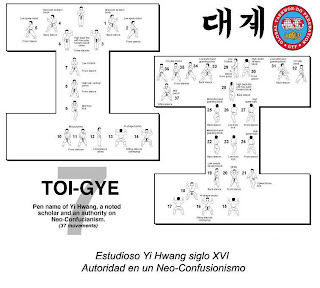
 TOI-GYE
is the penname of the noted scholar Yi Hwang(16th century A.D.), an authority on Neo-Confucianism. The 37 movements of this pattern refer to his birthplace on the 37th degree latitude, and the diagram represents "scholar". [37 moves]
 HWA-RANG
is named after the Hwa-Rang youth group which originated in the Silla Dynasty about 1350 years ago. This group eventually became the actual driving force for the unification of the three Kingdoms of Korea. The 29 movements refer to the 29th Infantry Division where Taekwon-Do developed into maturity. [29 moves]

CHOONG-MOO
was the name given to the great Admiral Yi Sun-Sin of the Yi Dynasty. He was reputed to have invented the first armoured battleship(kobukson) which was the precursor of the present day submarine in 1592A.D. The reason why this pattern ends in the left hand attack is to symbolize his regrettable death having had no chance to show his unrestrained potential checked by the forced reservation of his loyalty to the king. [30 moves]
SAJU-JIRUGI
SAJU-MAKGI
two fundamental exercises which are practiced by the beginner. Because they are not actually considered patterns, they have no historical significance.


CHON-JI
means literally the "Heaven and Earth". In the Orient, it is interpreted as the creation of the world or the beginning of human history. Therefore it is the initial pattern that is learned and played by the begginer. This pattern consists of two similar parts; one to represent the Heaven and the other the Earth. [19 moves]

is named after the holy Dan-Gun, legendary founder of Korea in 2333 B.C. [21 moves]

is the pseudonym of the patriot Ahn Ch'ang-Ho (1876-1938A.D.), who devoted his entire life to furthering the education of Korea and its independence movement. [24 moves]

was the noted monk who introduced Buddhism to the Silla dynasty in 686A.D. [28 moves]

YUL-GOK
is the pseudonym of the great philosopher and scholar Yi I(1536-1584A.D.), nicknamed the "Confucius of Korea". The 38 movements of this pattern refer to his birthplace on the 38th degree latitude and the diagram represents "scholar". [38 moves]

JOONG-GUN
is named after the patriot An Joong-Gun who assassinated Hiro-Bumi Ito, the first Japanese governor-general of Korea, known as the man who played the leading part in Korea-Japan merger. There are 32 movements in this pattern to represent Mr. An's age when he was executed in Lui-Shung prison in 1910. [32 moves]

is the penname of the noted scholar Yi Hwang(16th century A.D.), an authority on Neo-Confucianism. The 37 movements of this pattern refer to his birthplace on the 37th degree latitude, and the diagram represents "scholar". [37 moves]

is named after the Hwa-Rang youth group which originated in the Silla Dynasty about 1350 years ago. This group eventually became the actual driving force for the unification of the three Kingdoms of Korea. The 29 movements refer to the 29th Infantry Division where Taekwon-Do developed into maturity. [29 moves]

CHOONG-MOO
was the name given to the great Admiral Yi Sun-Sin of the Yi Dynasty. He was reputed to have invented the first armoured battleship(kobukson) which was the precursor of the present day submarine in 1592A.D. The reason why this pattern ends in the left hand attack is to symbolize his regrettable death having had no chance to show his unrestrained potential checked by the forced reservation of his loyalty to the king. [30 moves]
TAEKWON-DO STANCES
TAEKWON-DO STANCES
 |
| PARALLEL STANCE (NARANI SOGI) |
- Width = 1 shoulder width
- Feet parallel
- legs straight
 |
| ATTENTION STANCE (CHARYOT SOGI) |
- Heels touch
- Feet form the shape of a 'V'
- Legs straight
- Arms extended slightly outward to each side
 |
CLOSED STANCE (MOA SOGI)
|
- Feet together
- Legs straight
- 'A' position: Left hand wrapped over right fist, just below the line of sight (e.g. Won-Hyo)
- 'B' position: Left hand wrapped over right fist, forearms parallel to the floor (e.g. Joong-Gun)
- 'C' position: Hands flat, left over right lining up middle finger, arms straight (e.g. Hwa-Rang)
 |
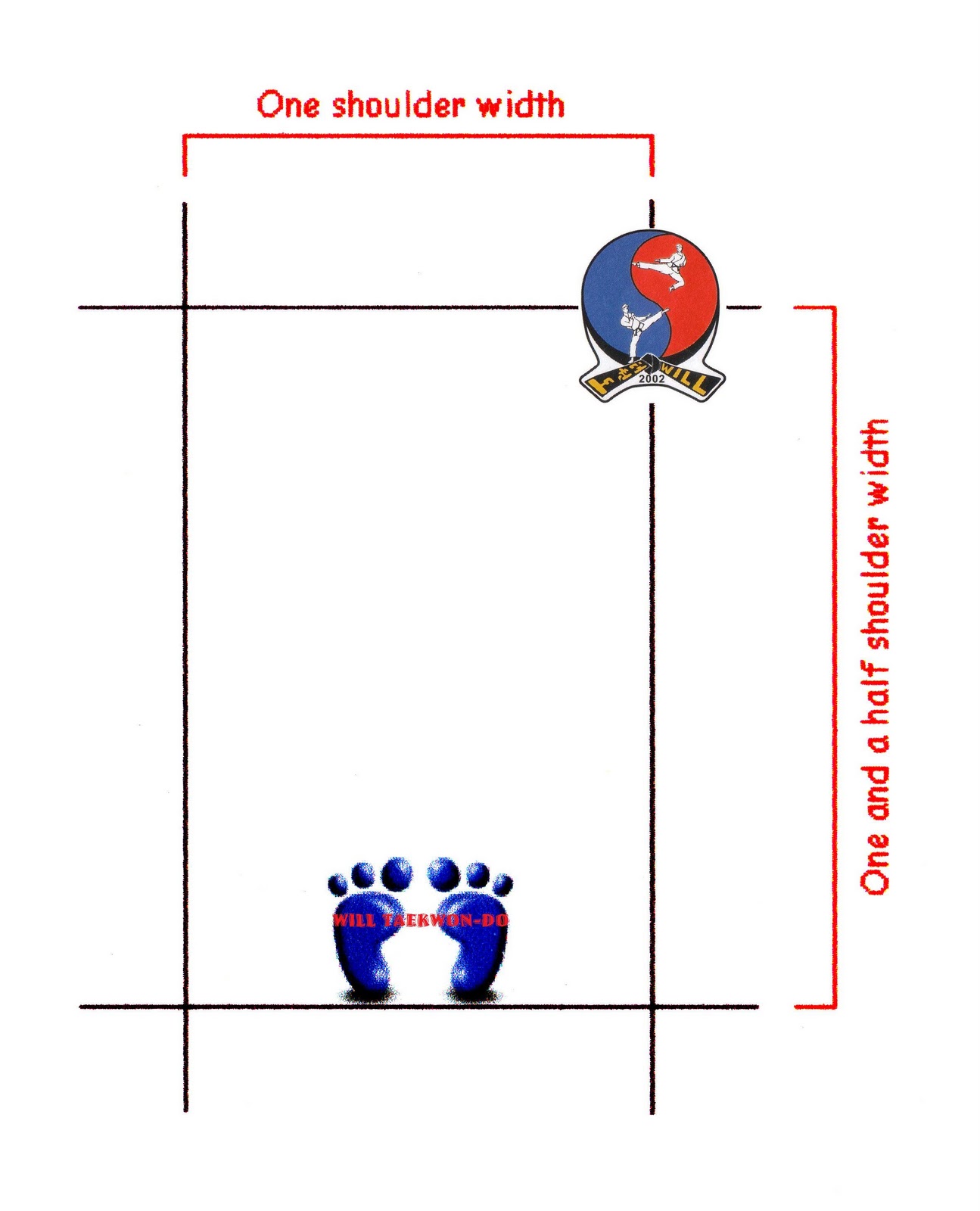
SITTING STANCE (ANNUN SOGI)
|
- Width = 1 1/2 shoulder width (inside measurement)
- Feet parallel
- Both knees bent
- Weight distribution: Left=50%, Right=50%
 |
| WALKING STANCE (GUNNUN SOGI) |
- Length = 1 1/2 shoulder width
- Width = 1 shoulder width
- Front foot straight, back foot turned outward 15'
- Weight distribution: Front=50%, Rear=50%
- Front knee bent, back leg straight
 |
| LOW WALKING STANCE (GUNNUN SOGI) |
- Length = 1 1/2 shoulder width + 1 foot length
- Width = 1 shoulder width
- Front foot straight, back foot turned outward 15'
- Weight distribution: Front=50%, Rear=50%
- Front knee bent, back leg straight
 |
FIXED STANCE (GOJUNG SOGI)
|
- Width = 1 shoulder width
- Length = 1 1/2 shoulder width + 1 foot length
- Feet form the shape of an 'L'
- Weight distribution: Front 30%, Rear 70%
- Both knees bent
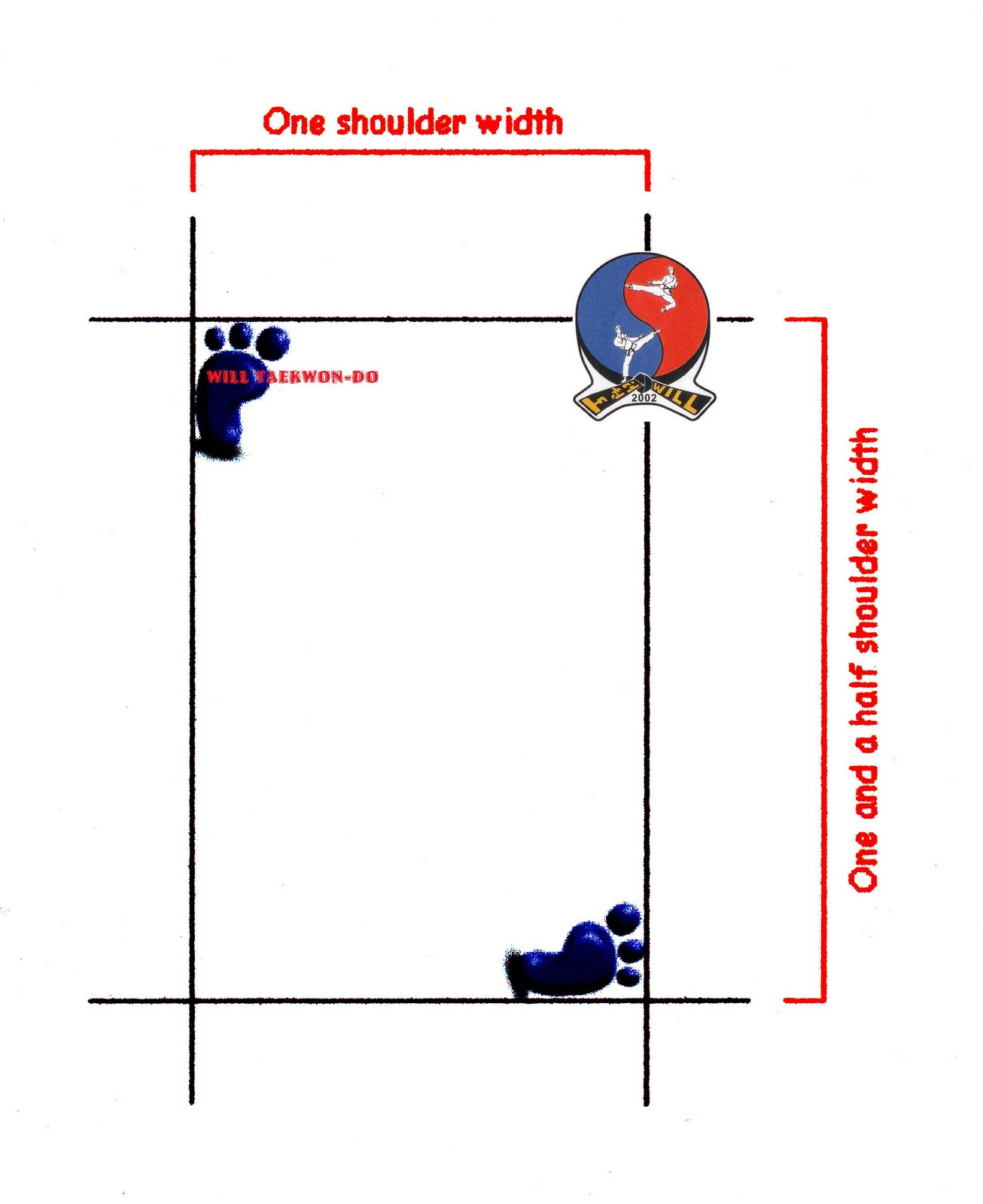 |
L-STANCE (NIUNJA SOGI)
|
- Width = 1 shoulder width
- Length = 1 1/2 shoulder width
- Feet form the shape of an 'L'
- Weighht distribution: Front=30%, Rear=70%
- Both knees bent
 |
| VERTICAL STANCE (SOOJIK SOGI) |
- Length = 1 shoulder width
- Feet form the shape of an 'L'
- Weight distribution: Front=40%, Rear=60%
- Legs straight
 |
| REAR STANCE (DWITBAL SOGI) |
- Length = 1 shoulder width
- Feet form the shape of an 'L'
- Front foot turned inward by 15', rear foot turned inward by 25'
- Weight distribution: Front=10%, Rear=90%
- Only the ball of the front foot touches the floor
 |
| ONE LEG STANCE (WAEBAL SOGI) |
- Standing straight on one leg
- position 'A': opposite foot parallel to the floor and angled next to the supporting knee - for side kick.
- Position 'B': Opposite foot parallel to the floor and flat next to the supporting knee - for back kick.
 |
| ONE LEG BENDING STANCE (GUBURYO SOGI) |
- Standing on one leg with supporting knee bent
- Position 'A': Opposite foot parallel to the floor and angled next to the supporting knee - for side kick.
- Position 'B': Opposite foot parallel to the floor and flat next to the supporting knee - for back kick.
 |
| DIAGONAL STANCE (SASUN SOGI) |
- Width = 1 1/2 shoulder width (inside measurement)
- Feet parallel
- Both knees bent
- Weight distribution: Left=50%, Right=50%
- Facing a 45' angle
 |
| X-STANCE (KYOCHA SOGI) |
- One foot behind the supporting foot
- Toes next to the outside edge of the supporting foot
- Front foot turned inward by 15', rear foot turned inward by 25'
- Weight distribution: Supporting foot=90%, Opposite foot=10%
- Both knees bent
WILL TAEKWON-DO KICKS
Axe Kick / Downward Kick / Chopping kick / Reverse Axe Kick
The Axe kick is a downward kick that requires a lot of flexibility. In Korean it is called ‘chiko chagi’.
The attacking leg raises upwards from in the inside or outside and is then brought crushing down the centre line of the opponent. The heel is used to strike the opponent in the head, face or chest. It can also be used on someone on the ground.
The attacking leg raises upwards from in the inside or outside and is then brought crushing down the centre line of the opponent. The heel is used to strike the opponent in the head, face or chest. It can also be used on someone on the ground.
Back Kick / Reverse Side Kick
The back kick is a technique where the kick is directed behind you. In Korean it is called ‘dwit chagi’.
It is essentially a reverse side kick therefore the keel is the main attacking tool.
It is essentially a reverse side kick therefore the keel is the main attacking tool.
Crescent Kick / Inner-Edge Kick / Outer-Edge Kick
The crescent kick is a kick where the leg comes at an arc from the inside or outside. In Korean it is called ‘bandal chagi’.
Flying Side Kick
Front Snap Kick / Front Kick / Front Thrusting Kick
The front snap kick is one of the first kicks you learn in Taekwondo. In Korean it is called ‘ap chagi’.
The front kick can be performed using the front or rear leg. It is important that the toes are pulled back as the sole of the foot is being used to strike. Whilst the kick can be performed high for targets such as the throat and face, it is predominantly used lower targets such as the groin and solar plexus.
The front kick can be performed using the front or rear leg. It is important that the toes are pulled back as the sole of the foot is being used to strike. Whilst the kick can be performed high for targets such as the throat and face, it is predominantly used lower targets such as the groin and solar plexus.
Front Stamping Kick
Heel Kick
Hook Kick / Reverse Hooking Kick
Jumping Back Kick
Jumping Front Kick
Jumping Reverse Hooking Kick
Jumping Reverse Turning Kick
Jumping Side Kick
Jumping Turning Kick
Knee Strike
Reverse Turning Kick
Also known as the reverse heel kick, reverse round kick and reverse roundhouse kick; the reverse turning kick is a spinning variation of the turning kick. In Korean it is called ‘bandae dollyo chagi’.
Rising Kick / Front Rising Kick / Side Rising Kick
Shin Kick
Side Kick / Side Thrusting Kick
The side kick is one of the most powerful moves in Martial Arts. In Korean it is called ‘yeop chagi’.
In order to perform the kick you first need to chamber the attacking leg and then rotate 90 degrees. The leg is then extended with the heel of the foot being used as the striking tool.
In order to perform the kick you first need to chamber the attacking leg and then rotate 90 degrees. The leg is then extended with the heel of the foot being used as the striking tool.
Turning Kick
Also known as a round kick or roundhouse kick, the turning kick is a powerful technique and one of the first moves learned in Taekwondo. In Korean it is called ‘dollyo chagi’.
The leg is thrown in a cicrular motion with the ball of the foot, instep or shin the main attacking tools. The turning kick can be used to attach all major parts of the body.
The leg is thrown in a cicrular motion with the ball of the foot, instep or shin the main attacking tools. The turning kick can be used to attach all major parts of the body.
Twisting Kick / Reverse Twisting Kick
Tornado Kick / 360 Kick / Crescent Tornado Kick / Reverse Tornado Kick
The Tornado kick, also known as the 360 kick since the leg moves around 360 degrees, is a popular technique which is used in Technique. The same leg is used for taking off, kicking and landing.
There are many variations of the kick including the reverse tornado kick and the crescent tornado kick.
There are many variations of the kick including the reverse tornado kick and the crescent tornado kick.
STEP/S SPARRING
Three Step Sparring (Sambo Matsogi)
Three step sparring is the first pre-arranged sparring sequence an ITF practitioner will learn. You may find that the exact way it is performed changes from country to country, city to city and club to club.
Generally speaking three step sparring works like this.
- Both attacker and defender take an attention stance and exchange bows.
- The attacker moves forward and places his right foot to the outside of the defenders left foot and then pulls back to form a left footed walking stance with a low forearm block. Both attacker and defender both shout ‘ki’ when ready.
- The attacker then performs forward with an obverse middle punch. The defender steps back and performs an inside or outside block. This is performed three times.
- Following the third punch, the defender will block the obverse middle punch and perform an attacking move on the initial attacker such as a punch or knife-hand strike.
- Both attacked and defender return to parallel ready stance and the whole process starts again with the defender now attacking and the attacker now defending.
Two Step Sparring (Ibo Matsogi)
Two step sparring is very similar to three step sparring. Instead of 3 punches by the attacker, a hand and then foot technique is performed (or foot then punch).
Like 3 step sparring, the attacker pulls back into a left walking stance and lower forearm block. After the attacker performs a hand and foot technique, the defender attacks back with a hand or foot technique. The attacker and defender then switch.
Like 3 step sparring, the attacker pulls back into a left walking stance and lower forearm block. After the attacker performs a hand and foot technique, the defender attacks back with a hand or foot technique. The attacker and defender then switch.
One Step Sparring (Ilbo Matsogi)
One step is the final pre-arranged sparring technique you learn. The attacker performs a hand or foot technique and the defender blocks and retaliates; either in the same move or quick succession.
You may choose to have both attacker and defender start in parallel stance at the start or the attacker pull back like normal.
You may choose to have both attacker and defender start in parallel stance at the start or the attacker pull back like normal.
BELT TEST QUESTIONS
This is a list of sample questions that you may be asked during a belt test. It is by no means comprehensive and should not be considered as such.
1. Who is the founder of Taekwon-Do?
2. Who is the founder of ITF?
3. Who is the founder of GTF?
4. Who is the founder of MGTF?
5. Who is the founder of NPM TKD ASSO.?
6. Who is the founder of WILL Taekwon-DO?
7. What year was Taekwon-Do founded?
8. What year was WILL Taekwon-Do founded?
9. In what nation was Taekwon-Do founded?
10. In what nation was WILL Taekwon-Do founded?
11. What is the name of the international Taekwon-Do organisation to which you belong?
12. What is the name of the national taekwon-Do organisation to which you belong?
13. What is the name of the association to which you belong?
14. What is the name of the group to which you belong?
15. Who is the Chief Instructor for the nation?
16. Who is the President for NPM TKD Asso.?
17. Who is the Chief Instructor for "Daerah Kulim/ Bandar Baharu"?
18. Why do students bow to the flag, instructor and senior students?
19. What are the tenets of Taekwon-Do and what does each one mean?
20. What is the ITF oath and what does each statement mean?
21. What is the GTF oath and what does each statement mean?
22. What is the WILL Taekwo-Do student oath and what does each statement mean?
1. Who is the founder of Taekwon-Do?
2. Who is the founder of ITF?
3. Who is the founder of GTF?
4. Who is the founder of MGTF?
5. Who is the founder of NPM TKD ASSO.?
6. Who is the founder of WILL Taekwon-DO?
7. What year was Taekwon-Do founded?
8. What year was WILL Taekwon-Do founded?
9. In what nation was Taekwon-Do founded?
10. In what nation was WILL Taekwon-Do founded?
11. What is the name of the international Taekwon-Do organisation to which you belong?
12. What is the name of the national taekwon-Do organisation to which you belong?
13. What is the name of the association to which you belong?
14. What is the name of the group to which you belong?
15. Who is the Chief Instructor for the nation?
16. Who is the President for NPM TKD Asso.?
17. Who is the Chief Instructor for "Daerah Kulim/ Bandar Baharu"?
18. Why do students bow to the flag, instructor and senior students?
19. What are the tenets of Taekwon-Do and what does each one mean?
20. What is the ITF oath and what does each statement mean?
21. What is the GTF oath and what does each statement mean?
22. What is the WILL Taekwo-Do student oath and what does each statement mean?
BELT TEST REQUIREMENT-SELF-DEFENSE MODULE-BREAKFALL
BREAKFALL TECHNIQUES
(FOR BLACK-BELT APPLICANT OF ALL DEGREES/LEVELS)
SIDE-FALL/ SIDE BREAKFALLS
1. LEFT SIDE-FALL
2. RIGHT SIDE-FALL
FRONT-FALL/ FORWARD ROLLING BREAKFALL/ FRONT OVERHEAD ROLLING
1. FRONT FALL
BACK-FALL/ BACKWARD BREAKFALL
1. BACK FALL
(FOR BLACK-BELT APPLICANT OF ALL DEGREES/LEVELS)
SIDE-FALL/ SIDE BREAKFALLS
1. LEFT SIDE-FALL
2. RIGHT SIDE-FALL
FRONT-FALL/ FORWARD ROLLING BREAKFALL/ FRONT OVERHEAD ROLLING
1. FRONT FALL
BACK-FALL/ BACKWARD BREAKFALL
1. BACK FALL
BELT TEST REQUIREMENT-SELF DEFENSE MODULE-THROWING
FOOT OR LEG TECHNIQUES
(1ST DEGREE BLACK-BELT TEST=ANY TWO, 2ND DEGREE BLACK-BELT TEST=ANY FOUR AND ADDITIONAL TWO TECHNIQUES FOR EVERY SUBSEQUENT BLACK-BELT DEGREE UNTIL COMPLETION)
1. LEG WHEEL
2. ADVANCING FOOT SWEEP
3. LIFT-PULL FOOT SWEEP
4. KNEE WHEEL
5. MINOR OUTER HOOK
6. MINOR OUTER REAP
7. MINOR INNER HOOK
8. MINOR INNER REAP
9. TWO-STEP MINOR OUTER HOOK
10.TWO-STEP MINOR OUTER REAP
11.MAJOR WHEEL
12.DOUBLE FOOT SWEEP
13.MAJOR OUTER HOOK
14.MAJOR OUTER REAP
15.MAJOR OUTER WHEEL
16.MAJOR OUTER DROP
17.MAJOR INNER HOOK
18.MAJOR INNER REAP
19.PROPPING DRAWING ANKLE
20.INNER THIGH THROW
HIP TECHNIQUES
(1ST DEGREE BLACK-BELT TEST=ANY TWO, 2ND DEGREE BLACK-BELT TEST=ANY FOUR AND ADDITIONAL TWO TECHNIQUES FOR EVERY SUBSEQUENT BLACK-BELT DEGREE UNTIL COMPLETION)
1. HIP SPRING
2. SWEEPING HIP
3. WINDING HIP SWEEP
4. HIP WHEEL
5. MAJOR HIP THROW
6. SLEEVE LIFT-PULL HIP THROW
7. FISHING/LIFTING HIP THROW
8. LIFT-PULL HIP THROW
9. FLOATING HIP THROW
10.REAR HIP THROW
11.HIP TRANSFER THROW
HAND TECHNIQUES
(1ST DEGREE BLACK-BELT TEST=ANY TWO, 2ND DEGREE BLACK-BELT TEST=ANY FOUR AND ADDITIONAL TWO TECHNIQUES FOR EVERY SUBSEQUENT BLACK-BELT DEGREE UNTIL COMPLETION)
1. LEG GRAB
2. ONE-ARM SHOULDER THROW
3. SHOULDER WHEEL
4. HEEL TRIP
5. DOUBLE LEG GRAB
6. TWO-HANDED SHOULDER THROW
7. SHOULDER DROP
8. SCOOPING THROW
9. CORNER DROP
10.BODY DROP
11.HAND WHEEL
12.HAND DROP
13.ARM ROLL
14.FLOATING DROP
15.MOUNTAIN STORM
SACRIFICE TECHNIQUES
(1ST DEGREE BLACK-BELT TEST=ANY TWO, 2ND DEGREE BLACK-BELT TEST=ANY FOUR AND ADDITIONAL TWO TECHNIQUES FOR EVERY SUBSEQUENT BLACK-BELT DEGREE UNTIL COMPLETION)
1. SPRINGING WRAP-AROUND THROW
2. MAJOR OUTER WINDING
3. OUTSIDE WINDING
4. CORNER THROW
5. VALLEY DROP
6. CIRCULAR THROW
7. WINDING INNER THIGH THROW
8. FLOATING THROW
9. REAR THROW
10.SIDE HOOK
11.SIDE WHEEL
12.SIDE DROP
13.SIDE SACRIFICE TECHNIQUE
14.SIDE SEPERATION
(1ST DEGREE BLACK-BELT TEST=ANY TWO, 2ND DEGREE BLACK-BELT TEST=ANY FOUR AND ADDITIONAL TWO TECHNIQUES FOR EVERY SUBSEQUENT BLACK-BELT DEGREE UNTIL COMPLETION)
1. LEG WHEEL
2. ADVANCING FOOT SWEEP
3. LIFT-PULL FOOT SWEEP
4. KNEE WHEEL
5. MINOR OUTER HOOK
6. MINOR OUTER REAP
7. MINOR INNER HOOK
8. MINOR INNER REAP
9. TWO-STEP MINOR OUTER HOOK
10.TWO-STEP MINOR OUTER REAP
11.MAJOR WHEEL
12.DOUBLE FOOT SWEEP
13.MAJOR OUTER HOOK
14.MAJOR OUTER REAP
15.MAJOR OUTER WHEEL
16.MAJOR OUTER DROP
17.MAJOR INNER HOOK
18.MAJOR INNER REAP
19.PROPPING DRAWING ANKLE
20.INNER THIGH THROW
HIP TECHNIQUES
(1ST DEGREE BLACK-BELT TEST=ANY TWO, 2ND DEGREE BLACK-BELT TEST=ANY FOUR AND ADDITIONAL TWO TECHNIQUES FOR EVERY SUBSEQUENT BLACK-BELT DEGREE UNTIL COMPLETION)
1. HIP SPRING
2. SWEEPING HIP
3. WINDING HIP SWEEP
4. HIP WHEEL
5. MAJOR HIP THROW
6. SLEEVE LIFT-PULL HIP THROW
7. FISHING/LIFTING HIP THROW
8. LIFT-PULL HIP THROW
9. FLOATING HIP THROW
10.REAR HIP THROW
11.HIP TRANSFER THROW
HAND TECHNIQUES
(1ST DEGREE BLACK-BELT TEST=ANY TWO, 2ND DEGREE BLACK-BELT TEST=ANY FOUR AND ADDITIONAL TWO TECHNIQUES FOR EVERY SUBSEQUENT BLACK-BELT DEGREE UNTIL COMPLETION)
1. LEG GRAB
2. ONE-ARM SHOULDER THROW
3. SHOULDER WHEEL
4. HEEL TRIP
5. DOUBLE LEG GRAB
6. TWO-HANDED SHOULDER THROW
7. SHOULDER DROP
8. SCOOPING THROW
9. CORNER DROP
10.BODY DROP
11.HAND WHEEL
12.HAND DROP
13.ARM ROLL
14.FLOATING DROP
15.MOUNTAIN STORM
SACRIFICE TECHNIQUES
(1ST DEGREE BLACK-BELT TEST=ANY TWO, 2ND DEGREE BLACK-BELT TEST=ANY FOUR AND ADDITIONAL TWO TECHNIQUES FOR EVERY SUBSEQUENT BLACK-BELT DEGREE UNTIL COMPLETION)
1. SPRINGING WRAP-AROUND THROW
2. MAJOR OUTER WINDING
3. OUTSIDE WINDING
4. CORNER THROW
5. VALLEY DROP
6. CIRCULAR THROW
7. WINDING INNER THIGH THROW
8. FLOATING THROW
9. REAR THROW
10.SIDE HOOK
11.SIDE WHEEL
12.SIDE DROP
13.SIDE SACRIFICE TECHNIQUE
14.SIDE SEPERATION
BELT TEST REQUIREMENT-MARTIAL ARTS TOOL MODULE-TRADITIONAL WEAPONS & SKILLS
TO ATTAIN THE STATUS, RECORNITION AND CERTIFICATION OF WORLD MARTIAL ARTS, ONE MUST ACHIEVE THE FOLLOWING CRITERIA AND STANDARD,
TESTING WILL BE BASED ON THE FOLLOWING:
BASIC INDIVIDUAL MOVEMENTS, SERIES MOVEMENTS, CREATIVE SERIES MOVEMENTS, PRACTICAL MOVEMENTS AGAINST VARIOUS SITUATIONS AND TOOLS.
MODULE REQUIREMENT FOR ACQUIRING:
1ST DEGREE BLACK-BELT
1. BO
2. JO
2ND DEGREE BLACK-BELT
1. BATON
2. ESKRIMA
3RD DEGREE BLACK-BELT
1. NUNCHAKU
4TH DEGREE BLACK-BELT
1. TONFA/ T-BATON(S)
5TH DEGREE BLACK-BELT
1. SAI
6TH DEGREE BLACK-BELT
1. FIREARMS/ SHOOTING
7TH DEGREE BLACK-BELT
1. HANDHELD BALLISTA
2. ARCHERY
8TH DEGREE BLACK-BELT
1. KNIFE/ DAGGER/ BUTTERFLY KNIFE
2. KATANA/ WAKIZASHI/ TANTO
9TH DEGREE BLACK-BELT
1. THROWING COIN/ KNIFE/ SHURIKEN/ STICK
2. KUSARI/ ROPE
3. KUSARI-STEEL BALL/ KNIFE/ KAMA
TESTING WILL BE BASED ON THE FOLLOWING:
BASIC INDIVIDUAL MOVEMENTS, SERIES MOVEMENTS, CREATIVE SERIES MOVEMENTS, PRACTICAL MOVEMENTS AGAINST VARIOUS SITUATIONS AND TOOLS.
MODULE REQUIREMENT FOR ACQUIRING:
1ST DEGREE BLACK-BELT
1. BO
2. JO
2ND DEGREE BLACK-BELT
1. BATON
2. ESKRIMA
3RD DEGREE BLACK-BELT
1. NUNCHAKU
4TH DEGREE BLACK-BELT
1. TONFA/ T-BATON(S)
5TH DEGREE BLACK-BELT
1. SAI
6TH DEGREE BLACK-BELT
1. FIREARMS/ SHOOTING
7TH DEGREE BLACK-BELT
1. HANDHELD BALLISTA
2. ARCHERY
8TH DEGREE BLACK-BELT
1. KNIFE/ DAGGER/ BUTTERFLY KNIFE
2. KATANA/ WAKIZASHI/ TANTO
9TH DEGREE BLACK-BELT
1. THROWING COIN/ KNIFE/ SHURIKEN/ STICK
2. KUSARI/ ROPE
3. KUSARI-STEEL BALL/ KNIFE/ KAMA


Subscribe to:
Posts (Atom)